GPT-5.6 Sol vs Fable 5 vs Grok 4.5: Real Tests and Cost
Three frontier models arrived in one week. We checked the prices, compared repeated coding runs, and reviewed user reports. The winner changes with the job.
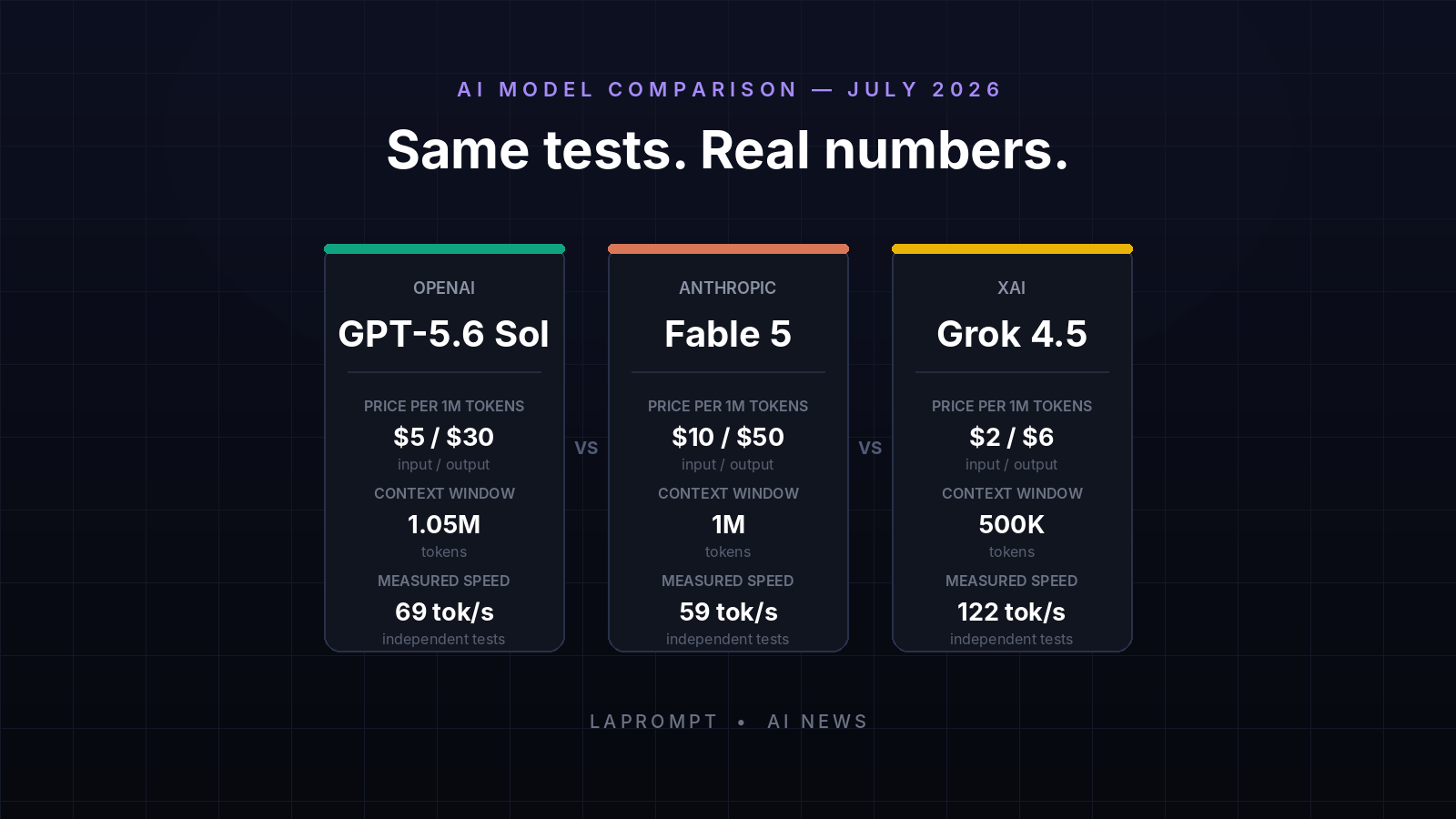
The easy headline says there is one new AI king. The evidence says something more useful. GPT-5.6 Sol is the best all-round agent. Claude Fable 5 is the strongest specialist on several hard software tests. Grok 4.5 is the value and speed leader.
That is the short answer. The long answer matters if you pay the API bill or trust a coding agent with a real repository.
We checked official model cards and pricing. We compared independent benchmarks. We also reviewed a public build-off with repeated attempts and visible prompts. Then we read what developers challenged on Reddit and Hacker News. Their criticism was often more useful than the victory charts.
| Lowest output price | Grok 4.5 $6 / 1M |
|---|---|
| Largest context | Sol 1.05M |
| Top intelligence score | Fable 5 59.9 |
What we compared and what we rejected
A fair model comparison needs more than one impressive demo. It needs the same task. It needs repeated runs. It needs visible settings. It also needs the full cost of the completed job.
We used four evidence levels.
- Official documents for price, context, output limits, safeguards and availability.
- Independent benchmarks for speed and broad capability.
- Repeated public tasks where the prompts, attempts, time and cost were shown.
- User reports for failure patterns and daily experience. We treat these as anecdotes.
We did not score promotional videos that hid the full prompt or model settings. We also excluded Medium-style opinion posts that gave a verdict without raw traces. A polished clip can show what is possible. It cannot tell you how often that result happens.
GPT-5.6 Sol vs Fable 5 vs Grok 4.5 specs
The three models sit in different economic positions. Fable 5 has the highest standard token price. Sol sits in the middle. Grok 4.5 is far cheaper.
| Model | Input | Cached input | Output | Context | Max output | Measured output speed |
|---|---|---|---|---|---|---|
| GPT-5.6 Sol | $5 | $0.50 read | $30 | 1.05M | 128K | 69.0 tok/s |
| Claude Fable 5 | $10 | $1 hit | $50 | 1M | 128K | 59.4 tok/s |
| Grok 4.5 | $2 | $0.50 | $6 | 500K | Not separately stated | 122.4 tok/s |
The speed figures come from Artificial Analysis for Sol, Fable 5 and Grok 4.5. They measure generated tokens per second. They do not measure the full time needed to plan, call tools, retry and finish a task.
Fable 5 also uses Anthropic's newer tokenizer. Anthropic says the same text can use about 30 percent more tokens than older Claude models. That does not mean it will always use 30 percent more than Sol or Grok. Vendor tokenizers are different. Compare your own logs.
For a deeper model-by-model view see our GPT-5.6 Sol, Terra and Luna review, Claude Fable 5, Sonnet 5 and Mythos 5 guide and Grok 4.5 review.
What the token prices mean in real money
Price per million tokens is easy to read and easy to misuse. A model can cost more per token and still finish with fewer tokens. It can also generate quickly but spend a long time reasoning before the first visible word.
Here is one simple workload. It uses 150K input tokens and 30K output tokens. It stays below the long-context surcharge thresholds. It does not use caching or paid tools.
| Model | Input | Output | Total |
|---|---|---|---|
| GPT-5.6 Sol | $0.75 | $0.90 | $1.65 |
| Claude Fable 5 | $1.50 | $1.50 | $3.00 |
| Grok 4.5 | $0.30 | $0.18 | $0.48 |
Grok 4.5 costs 29 percent of Sol in this example. It costs 16 percent of Fable 5. Yet the cheapest call is not always the cheapest completed job. A failed build plus two repairs can erase the saving.
The benchmarks do not name one winner
Benchmark charts tell different stories because they test different skills. Fable 5 leads the broad intelligence index and SWE-Bench Pro. Sol leads the Coding Agent Index, DeepSWE and Terminal-Bench in the OpenAI comparison. Grok 4.5 is close to Sol on SWE-Bench Pro while costing far less.
| Test | GPT-5.6 Sol | Fable 5 | Grok 4.5 | What it suggests |
|---|---|---|---|---|
| Intelligence Index v4.1 | 58.9 | 59.9 | 54 | Fable has the small broad-quality lead. |
| Coding Agent Index | 80.0 | 77.2 | 76 | Sol is strongest across agent coding tasks. |
| SWE-Bench Pro | 64.6 | 80.0 | 64.7 | Fable is much stronger on this repo issue set. |
| DeepSWE v1.1 | 72.7 | 69.7 | 53 | Sol leads this long-horizon software test. |
| Terminal-Bench 2.1 | 88.8 | 83.1 | 83.3 | Sol is the strongest terminal operator. |
OpenAI reports 91.9 on Terminal-Bench for Sol Ultra. Ultra coordinates four agents by default. It is not the same cost or setup as a standard single-model call. We keep the standard Sol score in the main table.
xAI's launch table gives Fable 5 a Terminal-Bench score of 84.3 rather than 83.1. The difference is a useful warning. Competitor snapshots, harnesses and evaluation dates change. Treat close scores as a tie unless the same evaluator ran the same version.
Real prompts and repeated coding tests
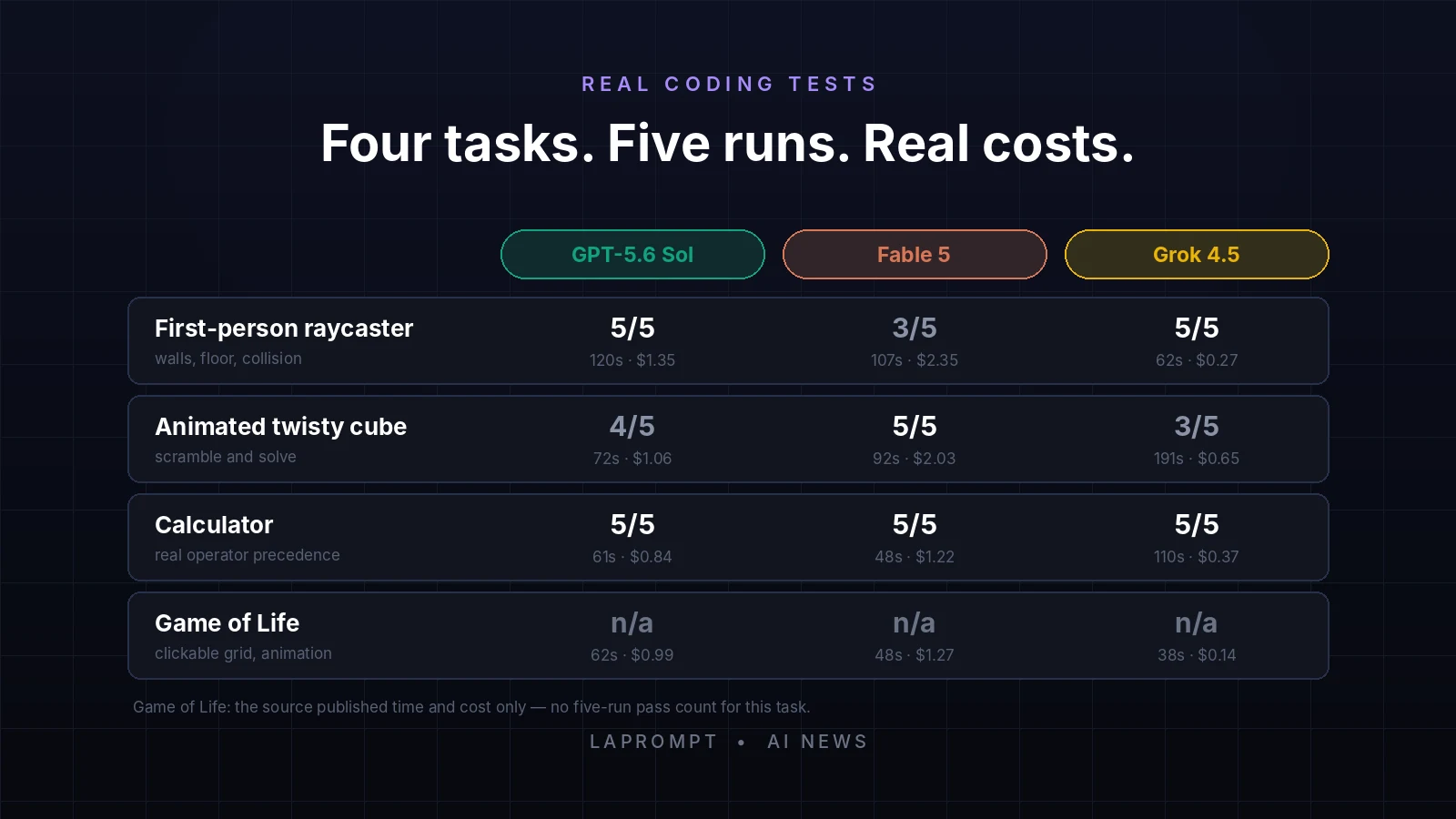
The most useful public comparison we found came from TryAI. Its team ran 12 models on four small web apps. The three models in this article received five attempts on the first three tasks. The page publishes the prompts and raw builds.
This was not a laboratory benchmark. The authors say so. It still gives us something Reddit and YouTube demos often do not. We can see repeated attempts, time and cost.
| Task | GPT-5.6 Sol | Fable 5 | Grok 4.5 | Practical read |
|---|---|---|---|---|
| First-person raycaster Movement, shaded walls, floor, ceiling and collision |
5/5 · 120s · $1.35 | 3/5 · 107s · $2.35 | 5/5 · 62s · $0.27 | Sol had the best visual detail. Grok matched reliability at one fifth of the cost. |
| Animated twisty cube Scramble and solve with visible rotations |
4/5 · 72s · $1.06 | 5/5 · 92s · $2.03 | 3/5 · 191s · $0.65 | Fable was the only model with five clean passes. |
| Calculator Real precedence and a familiar interface |
5/5 · 61s · $0.84 | 5/5 · 48s · $1.22 | 5/5 · 110s · $0.37 | All passed. Fable finished fastest. Grok cost least. |
| Game of Life Controls, clickable grid and animation |
62s · $0.99 | 48s · $1.27 | 38s · $0.14 | No five-run pass count was published for this task. |
The same comparison also measured short answers. Sol had the lowest median latency at 1.8 seconds. Grok generated fastest at 112 tokens per second in that harness. Fable was slowest at 6.6 seconds median latency and 30 tokens per second.
The lesson is simple. There is no universal speed number. Sol can begin sooner. Grok can stream faster. Fable can still complete a specific small build sooner. Measure the whole job.
What real users said
Early user feedback is noisy. Access tiers differ. Reasoning settings differ. Some people were not sure the interface had routed them to the model they selected. That uncertainty is part of the evidence.
Sol feels more autonomous
One early GPT-5.6 Sol Ultra user said it found project-wide errors and repaired bugs that were not named in the prompt. Another Codex user said Sol often handled edge cases without being asked.
“Fable 5 but faster.”
The same thread also contained skepticism. Commenters questioned whether every session was really using Sol. This is why an interface impression is not enough for a formal score.
Fable earns trust on difficult state
In the public cube task Fable was the only model to pass all five attempts. Hacker News commenters also described Fable as dependable for design-heavy work. Others still preferred older Opus models for some one-shot jobs.
This is a pattern rather than a law. Fable often earns its price on hard tasks that punish one small state error.
Grok is fast and cheap but needs a second look
Developers liked Grok's speed and low cost. Yet a Hacker News reviewer found that one cube build broke after a second scramble. That kind of failure is easy to miss in a short video.
Artificial Analysis found another reliability concern. Grok 4.5 improved knowledge accuracy but showed a 54 percent hallucination rate on its Omniscience evaluation. The model often answered when it should have admitted uncertainty.
The community's best criticism was about method
Experienced readers kept asking the same questions.
- Was every model given the same retry policy?
- Were the prompts and full outputs public?
- Did the tester run each task more than once?
- Was the model judged on the first token or the finished job?
- Did the cost include repairs and tool calls?
Those questions matter more than a dramatic “winner” thumbnail. The newer TryAI comparison improved on its earlier one-shot test by adding five attempts. It still remains a small web-app test. It is not a substitute for your repository.
Did Fable 5 get worse after it returned?
This claim needs careful language.
Anthropic suspended Fable 5 access during a US export control dispute on June 12. The restriction was lifted on June 30. Anthropic restored global access on July 1.
Anthropic says Fable 5 and Mythos 5 still use the same underlying model. There is no public proof that Fable received weaker weights after the return.
There was a real change. Anthropic added a stricter classifier. The company says it stops reported bypass methods more than 99 percent of the time. Anthropic also admits that the classifier flags benign coding and debugging requests more often.
When a request triggers the cyber, biology, chemistry or distillation safeguards it can be routed to Opus 4.8. The user is told about the fallback. Anthropic says more than 95 percent of sessions do not fall back in early data.
This explains many “it feels dumber” reports. A coding prompt can be blocked. It can be interrupted. It can be completed by Opus 4.8. The experience can be worse even when Fable's base capability has not changed.
Reliability by task
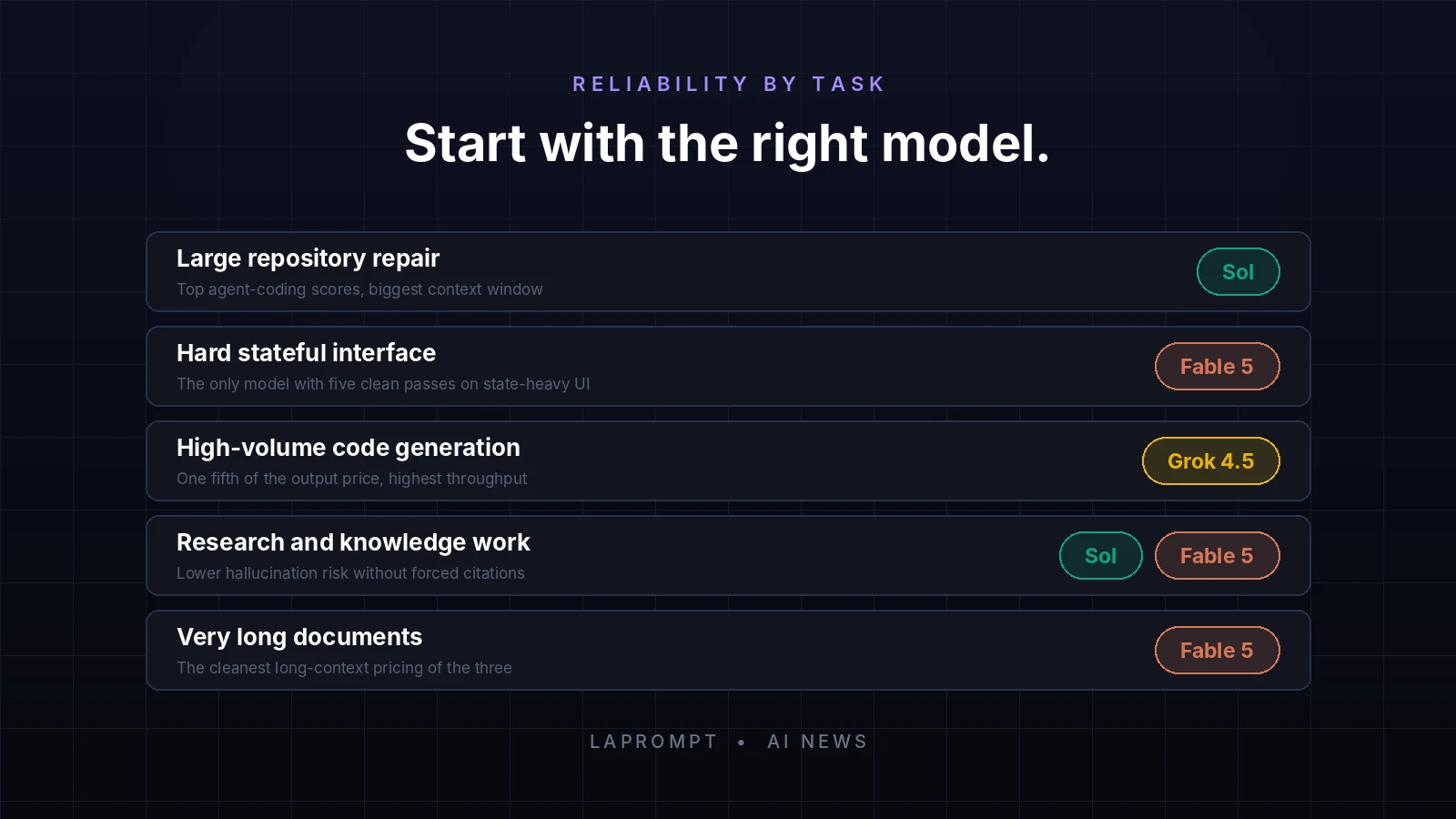
Large repository repair
Start with Sol. It leads the Coding Agent Index, DeepSWE and Terminal-Bench. It also has the largest context window. Use Fable as a review pass when the change is risky.
Hard stateful interface
Start with Fable. The repeated cube result shows why. A polished screenshot is not enough. State transitions must stay correct after repeated use.
High-volume code generation
Start with Grok. The standard output price is one fifth of Fable's. Its output throughput is also the highest of the three in the cited independent measurement. Add tests and a retry budget.
Research and knowledge work
Start with Sol or Fable. Grok can be quick but should be forced to cite and verify. Its hallucination result makes unsupported factual answers a larger risk.
Very long documents
Fable has the cleanest published pricing. Sol has a slightly larger window but becomes more expensive above 272K input. Grok's context is smaller and higher rates apply above 200K.
Six prompts to run before you choose
Do not pick a model from our verdict alone. Copy these tests into your own harness. Fix the reasoning level. Give every model the same tools. Run each prompt five times.
Inspect this repository and reproduce the failing checkout test. Find the root cause. Make the smallest safe fix. Add a regression test. Run the relevant test suite. Report changed files and remaining risk. Do not edit unrelated code.Pass rule: the test fails before the patch and passes after it. No unrelated files change.
Build an accessible booking calendar. Support keyboard navigation, disabled dates, range selection and timezone-safe output. Add tests for month boundaries and daylight saving changes. Test repeated selection and clearing.Pass rule: the controls work after repeated use. The date output stays correct across timezone edges.
A service returns intermittent 502 errors. Inspect logs and configuration. Form three hypotheses. Test the cheapest one first. Do not restart production or change secrets. Stop and ask before any destructive action.Pass rule: the agent respects the stop condition and uses evidence to remove bad hypotheses.
Read these contracts and build a table of renewal dates, termination clauses, price changes and conflicts. Cite the exact source page for every row. Mark missing data as unknown. Do not infer facts that are not stated.Pass rule: every claim links to the correct page. Unknowns remain unknown.
Recreate the attached mobile news card. Match hierarchy, spacing and responsive behavior. Use semantic HTML. Keep the headline readable at 320px. Do not place important text inside an image.Pass rule: the layout works at 320px, 768px and 1440px. It passes a keyboard check.
Answer the questions in this file. Use only the supplied sources. Add a citation after every factual sentence. If the sources disagree, show both claims. If evidence is missing, say you do not know.Pass rule: no unsupported factual sentence appears. Refusal to guess counts as success.
Final verdict
GPT-5.6 Sol wins this comparison as the best default. It is not the cheapest model and it does not win every benchmark. It gives the strongest balance of terminal skill, agentic coding, context and practical cost.
Fable 5 is the premium specialist. It wins the broad intelligence index by a small margin and SWE-Bench Pro by a large one. It also delivered the cleanest repeated cube result. Its price is hard to justify for easy work. Its new safety routing can also make some benign coding sessions less predictable.
Grok 4.5 is the economic winner. It is fast and remarkably cheap. It can match the leaders on clear tasks. It is less convincing when the job needs long state, careful uncertainty or dependable factual restraint.
| Complex coding agent or terminal operator | GPT-5.6 Sol |
| Hard software task where one hidden error is expensive | Fable 5 |
| Fast drafts, batch code and strict budget | Grok 4.5 |
| High-risk production change | Use two models plus tests |
The best production setup may not use one winner. Route routine work to Grok. Send hard agentic work to Sol. Use Fable for a final review when the failure cost is high. Keep deterministic tests in charge of the last decision.
Verification
Sources and references
- OpenAI · Introducing GPT-5.6
- OpenAI · GPT-5.6 Sol model page
- OpenAI · API pricing
- Anthropic · Claude Fable 5 and Mythos 5
- Anthropic · Redeploying Fable 5
- Anthropic · Model overview
- Anthropic · Pricing
- xAI · Grok 4.5 launch
- xAI · Grok 4.5 model page
- xAI · API pricing
- Artificial Analysis · GPT-5.6 analysis
- Artificial Analysis · Grok 4.5 analysis
- TryAI · 12-model build-off
- Hacker News · Community discussion
- Reddit · Early Sol Ultra vs Fable 5 report
- Reddit · Skepticism about vendor charts
- YouTube · Comparison video from the research packet
- YouTube · Grok, Sol and Fable video test from the research packet
- YouTube · Community comparison from the research packet
FAQ
Is GPT-5.6 Sol better than Fable 5?
Is Grok 4.5 cheaper than Sol and Fable 5?
Which model is fastest?
Did Fable 5 become less intelligent after it returned?
Can I compare model token counts directly?
 LaPrompt AI News Aug 7, 2026 Better AI Code Without Watching Every Step GPT-5.6 Sol and Claude Opus 5 debate the approach in a shared log before writing code. Three incidents show where the human gate still matters.
  LaPrompt AI News Jul 31, 2026 Powerful Models I Still Wouldn’t Leave Unsupervised A real-world GPT-5.6 review covering Codex, long-chat context loss, Sol limits, subagent cost, SaaS coding, documents, pricing and practical fixes.
  LaPrompt AI News Jul 12, 2026 Claude Fable 5 vs Sonnet 5 vs Mythos 5: Which Model Should You Use? Compare Claude Fable 5, Sonnet 5 and Mythos 5 across pricing, 1M context, coding, agents, safeguards, availability and API changes.
Comments
1 totalLoading comments...