Better AI Code Without Watching Every Step
Three AI models settle the approach in a shared file before any code is written. You check in occasionally and review the final result — the release gate stays human.
The wrong question in 2026 is “Which AI model should replace my development team?” The useful question is “Which model should handle this part of the job, under which limits, and who checks the result?”
This report comes from the engineering team at Skyron Intelligent Solutions. The team builds SaaS products, corporate portals, cloud systems and custom software. We spent a week using frontier coding models inside working projects. These were not clean benchmark repositories. They included a Next.js monolith, Python and Django services, C# and .NET code, Astro with React islands, database procedures and deployment pipelines.
We used GPT-5.6 Sol at high reasoning levels. We used Claude Opus 5 and Sonnet 5. We also evaluated Grok 4.5, DeepSeek V4 and Muse Spark 1.1 as possible routes in a wider system. Some results were excellent. Some were expensive. A few were dangerous. One agent reached production without the permission the team believed it had granted.
The conclusion is direct. A strong model can save hours. It can also make the wrong change with extraordinary confidence. The best setup is not one model with unlimited access. It is a small system of specialized models. They inspect the same task from different angles. A human technical lead decides what is allowed to move forward.
“A model that can do anything is not a model that should be allowed to do anything. We buy capability by the token. We still supply the judgement ourselves.”
What this test can and cannot prove
This is a field report. It is not a controlled laboratory benchmark. The team compared models through day-to-day engineering work. The repositories, prompts and tools were not identical for every run. That makes the observations useful for workflow design. It does not make every behavior a universal property of the underlying model.
We are not going to invent precision we do not have. Nobody instrumented this. Engineers reached for a model when a task called for one and worked without it when it did not. Some spent a full day inside an agent. Some spent an hour. Some days nobody did. Afterwards we collected what each of them had run into. That is the honest shape of the evidence, and it is the shape most of these reports actually have before the numbers are added.
We separate three kinds of evidence. Official capabilities and prices come from provider documentation. Workflow advice comes from the team’s repeated experience. Incidents are presented as incidents observed in a specific tool configuration. They should not be read as proof that every user will see the same result.
Why no single coding model wins
Frontier models look similar from a distance. They all write code. They all call tools. They all say they can reason across a repository. The difference appears when a task becomes messy.
A database migration can be valid in isolation and still break an application contract. A frontend refactor can look clean and still increase rendering work. A security workaround can make an error disappear while keeping the root cause alive. One model often follows the most visible path. A second model may notice what the first one ignored.
Skyron’s orchestrator uses that difference. For difficult work, GPT and Claude can examine the same problem through three to five review rounds. They do not need to produce the same answer. Disagreement is useful. It reveals where the evidence is weak.
One model may see a clean design. Another may detect the risk hiding behind it. The team needs both signals before it approves the change.
This is not a vote. Two models agreeing does not make a statement true. The goal is to expose assumptions. The final evidence still comes from the repository, runtime behavior, tests, logs and a human review.
A simple orchestration pattern
- Scope the task. Name the goal, allowed files, forbidden actions, acceptance tests and risk level. Do not start with “improve the project.”
- Ask for independent analysis. Give the same evidence to two models. Keep the first pass read-only. Ask each model to list uncertainty and the risk of applying its recommendations.
- Challenge the findings. Let each model review the other model’s claims. Require file references, runtime evidence or a reproducible test for every high-severity finding.
- Approve a bounded patch. A human chooses the fix. One agent implements it in a branch. A different agent reviews the diff. The implementation agent cannot deploy.
- Verify and release. Run tests, type checks, security checks and product-specific acceptance cases. Production remains behind a separate human-controlled gate.
Maximum reasoning is not a default
The biggest model with the highest reasoning setting feels like the safest choice. In practice, it can be the most wasteful one.
High reasoning helps when the task is ambiguous. It is valuable for architecture, difficult debugging and long multi-step work. It can be harmful when the task is a local fix. The model may search for a deeper design problem that is not relevant. It may invent abstractions. It may explore several branches and consume a large token budget before touching the obvious answer.
OpenAI’s current Codex guidance makes the same distinction. Low reasoning is for well-scoped work. Medium or high is for more complex changes. Extra High is for long and reasoning-heavy agentic tasks. The practical rule is simple. Use the lowest level that reliably passes the acceptance test.
The same warning applies to subagents. Current Codex documentation says each subagent performs its own model and tool work. A multi-agent run therefore consumes more tokens than a comparable single-agent run. “Use subagents for quality” is too open-ended. Name the exact number, role and deliverable.
Use exactly three review agents.

Agent 1: identify security risks.
Agent 2: identify test gaps.
Agent 3: identify maintainability risks.

Do not edit files.
Wait for all three.
Return one deduplicated report with file references.
Stop after the report.
The most dangerous prompt is “do a complex refactor”
Broad refactoring prompts create a permission problem disguised as a coding problem.
Consider this instruction: “Move logic into modules, remove duplication, update types and fix tests.” It sounds clear. It is not. Which duplication is accidental? Which repetition protects performance? Which public interfaces must not change? Which parts of the architecture are temporary? The model does not know unless the repository tells it.
In a full-stack Next.js monolith, both Claude Code and Codex can respond to a vague request by touching far more than the team intended. A compact structure can become a large hierarchy of components, helpers, wrappers and layouts. The diff may look organized. The product can become slower and harder to trace.

Skyron saw the same pattern with comments. A model can turn a concise codebase into a teaching document. Explanations spread into every function. Diffs become noisy. Real defects become harder to see. Code comments should explain a non-obvious invariant. They should not narrate every line.
Audit first. Edit second.
A better first instruction is read-only. It asks the model to identify risks and show evidence. It also asks for the risk of applying each proposed fix. This last part is easy to miss. A valid finding can still have a dangerous remedy.
Goal
Audit this repository for security, performance and reliability risks.

Scope
Analyze the files and services listed below. Read adjacent code only when
it is required to understand a dependency.

Constraints
- Do not modify files.
- Do not install packages.
- Do not change infrastructure or deployment settings.
- Do not infer a problem without evidence.

For every finding include
1. Severity
2. Evidence with file and symbol references
3. User or system impact
4. Confidence level
5. Proposed fix
6. Risk of applying that fix
7. A test that would confirm the problem

Done when
Return one deduplicated table. Stop and wait for approval.
Then define a local change
Do not say “clean up this area.” Explain what product behavior must change and why. Name the files that may change. Name the interfaces that must remain stable. State what the agent must not do.
Goal
Move the account-switching control from these two pages into the shared
header because the feature must be available from every authenticated page.

Allowed changes
- app/(dashboard)/components/AccountSwitcher.tsx
- app/(dashboard)/layout.tsx
- tests/account-switcher.spec.ts

Do not
- change API routes
- rename public types
- add a dependency
- change authentication behavior
- deploy or push

Done when
- the control appears in the shared header
- keyboard behavior is unchanged
- existing tests pass
- the new regression test passes
- the final response lists every changed file and remaining uncertainty
One Markdown contract that both agents obey
Repository instructions should survive the chat. At Skyron, important rules live in Markdown files at the repository root or inside a controlled docs directory. This reduces repeated prompting. It also keeps policy separate from implementation comments.
For Codex, AGENTS.md is the natural entry point. OpenAI documents that Codex reads these files before it starts work. A good file explains the repository layout, build and test commands, engineering conventions, prohibited actions and the definition of done.
Keep it short. Link to deeper documents. The root file is a map, not a book.
# Engineering agreement

## Repository map
- apps/web: Next.js product
- services/api: Django API
- infra: deployment code, read-only for agents
- docs/architecture.md: system boundaries

## Required checks
- pnpm lint
- pnpm typecheck
- pnpm test

## Hard rules
- Never deploy, push, merge or create releases.
- Never access production credentials.
- Ask before adding a production dependency.
- Keep comments limited to non-obvious invariants.
- Prefer a local patch over a repository-wide refactor.

## Done means
- acceptance behavior is demonstrated
- tests pass
- diff is reviewed for unrelated changes
- risks and uncertainty are listed
That file solves half of the problem. Codex reads AGENTS.md. Claude Code does not. It reads CLAUDE.md. Two agents working the same repository from two separate rule files is how they start disagreeing about what is allowed.
The answer is not a second rule set. Anthropic documents an import syntax for exactly this case: a CLAUDE.md that pulls in the existing agent file. At Skyron that file contains one line. The rules live in one document, and CLAUDE.md exists only because Claude Code will not read them under the other name.
@AGENTS.mdA symlink between the two files does the same job, but it requires Administrator rights or Developer Mode on Windows, so the one-line import is the portable choice. Either way the point is the same. Anthropic warns that contradictory instructions across files are resolved arbitrarily, and two agents drifting apart on what is permitted is not a documentation problem. It is an access problem waiting to happen.
A second file can track the work itself. A concise development log should record what changed, why it changed, what remains open and which commands verified the state. When a chat becomes bloated or slow, the next chat can load that durable record instead of reconstructing hours of conversation. In a two-model workflow that log is also the handoff. The agent reviewing a change was not present in the session that produced it, and the repository is the only memory both of them share.
OpenAI now recommends one chat per coherent outcome. It also warns that using one conversation for an entire project leads to bloated context and worse results. Skyron’s experience matches that guidance. A huge context window does not guarantee perfect attention. Old instructions, abandoned approaches and long tool output still compete for focus.
GPT-5.6 Sol vs Claude Opus 5 in real development
The models do not divide cleanly into “good” and “bad.” They have different working styles. The useful comparison is task by task.
| Task | Skyron’s preferred lead | Why | Guardrail |
|---|---|---|---|
| Database procedures and schema changes | GPT-5.6 Sol | Stronger system-wide view in our tests. It followed relationships across code, procedures and services more reliably. | Require migration tests, rollback steps and explicit schema scope. |
| Cross-service architecture | GPT-5.6 Sol | Useful when the answer depends on infrastructure, data flow and several repositories. | Plan first. Do not allow a broad autonomous rewrite. |
| Deep code review | Claude Opus 5 | Strong at reading intent, questioning assumptions and sustaining a long analysis. | Ask for evidence. Limit comments. Keep the first pass read-only. |
| Daily bounded implementation | Claude Sonnet 5 or GPT-5.6 Terra | Lower cost and latency than the top tiers for work with a clear definition of done. | Escalate only when tests expose real uncertainty. |
| Fast high-volume code tasks | Grok 4.5 | Competitive price and fast serving make it attractive for well-specified throughput work. | Measure accepted task cost, not provider claims alone. |
| Cheap pipeline tasks | DeepSeek V4 Flash | Very low token pricing can support classification, transformation and first-pass checks. | Use stronger review for high-impact output. |
| Multimodal and computer workflows | Muse Spark 1.1 | Meta positions it for coding, tool use, computer use and a one-million-token context. | Run in an isolated workspace with a strict tool allowlist. |
Where GPT-5.6 Sol stood out
Sol was most valuable when a task crossed boundaries. It could follow a database procedure into an API contract and then into application behavior. That does not mean it was always right. It means its first model of the whole system was often more useful.
OpenAI’s published results support the broader picture. GPT-5.6 Sol scores 91.9% in Ultra mode on Terminal-Bench 2.1 and 71.2% in standard mode on SEC-Bench Pro. The company also reports stronger long-context performance than GPT-5.5 in several tests. These are provider benchmarks. They are not a guarantee for a specific repository. They do explain why Sol feels comfortable with long, tool-heavy work.
Where Claude Opus 5 stood out
Opus 5 was a valuable reviewer and analytical partner. It could stay with a difficult question and surface product-level concerns. Anthropic describes it as a model for long-running agents and large code changes. Early customers quoted by Anthropic also report better root-cause analysis, verification and consistency than older Opus releases.
But a capable agent still follows the incentives in the prompt. If the prompt rewards “make the error disappear,” a workaround can look like success. The team must reward root-cause evidence instead.
Three failures that changed how we grant access
Three things went wrong during this test. Claude spent about an hour fighting a Windows Defender removal and proposed disabling the protection instead of explaining it. An unbounded test loop drove Chrome to roughly 50 GB of memory and restarted a 64 GB workstation more than once. An agent pushed to the wrong repository, and for several minutes one live site was serving another site.
Each produced a rule we now apply, and together they carry the argument the rest of this report rests on: an instruction describes intent, and a permission is what enforces it. The controls that changed afterwards are summarized in the production checklist below.
Data governance matters as much as model quality
The model is only one part of an AI coding product. The IDE extension decides which files become context. The service decides what it stores. The account tier decides which data terms apply. The organization decides whether logs, telemetry and file access are acceptable.
In one Skyron IDE setup, the team observed repository-related network activity that appeared to continue after a task was stopped. The behavior created enough concern that the team logged out and removed the tool from that confidential workflow.
That observation does not prove that Google trained on the repository or stored the whole codebase. It is important not to make that leap. Google’s current documentation says Gemini Code Assist Standard and Enterprise are stateless and do not store prompts and responses by default. It says the service can receive snippets from open files and adjacent files as context. Google also documents collection of service data such as user analytics and telemetry. It says customer prompts and responses are not used to train Gemini models without permission.
The product landscape also changed. Google retired consumer Gemini Code Assist access through its IDE extensions and Gemini CLI on June 18, 2026 and directed those users to Antigravity. A team evaluating the product today must check the exact tool and account tier. Old consumer behavior and current enterprise guarantees are not interchangeable.
Coding model prices as of August 7, 2026
Token price matters. It is not the final cost. A cheap model that creates a rejected patch is expensive. A premium model that resolves a production incident in one pass can be cheap. Measure cost per accepted task.
| Model | Input / 1M | Output / 1M | Best role in this workflow |
|---|---|---|---|
| GPT-5.6 Sol | $5 | $30 | Hard architecture, ambiguous debugging, cross-system review |
| GPT-5.6 Terra | $2 | $12 | Daily development and strong second-pass review |
| GPT-5.6 Luna | $0.20 | $1.20 | Well-specified implementation, tests and background automation |
| Claude Fable 5 | $10 | $50 | Highest-cost long-running Claude work where quality justifies the premium |
| Claude Opus 5 | $5 | $25 | Deep analysis, agentic coding, high-stakes review |
| Claude Sonnet 5 | $2 | $10 | Daily driver through August 31 introductory pricing |
| Grok 4.5 | $2 | $6 | Fast, high-volume coding and tool tasks |
| DeepSeek V4 Flash | $0.14 cache miss | $0.28 | Low-cost pipeline work and first-pass checks |
| DeepSeek V4 Pro | $0.435 cache miss | $0.87 | Low-cost deeper reasoning where availability fits |
| Muse Spark 1.1 | Public preview. Meta publishes no rate card; press reports cite about $1.25 and $4.25. | Multimodal, computer-use and orchestration experiments |
These are API list prices, not subscription quotas or a full project bill. Cache pricing, batch pricing, fast modes, regional providers and tool execution can change the total. Claude Sonnet 5 rises to $3 input and $15 output per million tokens on September 1, 2026 unless Anthropic changes the schedule. OpenAI cut Terra and Luna prices on July 30. Sol Fast mode costs twice the standard Sol rate, and Anthropic prices its Opus 5 fast mode at $10 input and $50 output.
DeepSeek’s published table is dramatically cheaper, but the service says peak pricing will become twice the regular rate after a future announcement. Its Responses API reached V4 Flash first, with V4 Pro following later. A procurement decision should check the live documentation again rather than trust any published table, including this one.
A better cost metric
For each model and task class, record five numbers:
- Total model and tool cost.
- Elapsed time.
- Human review time.
- Pass rate on acceptance tests.
- Percentage of the diff that survives review.
A model that writes 5,000 lines and keeps 500 has a hidden rejection cost. A model that writes 600 lines and keeps 550 may be the better bargain even at a higher token price.
Which model should your team use?
| Use case | Recommendation |
|---|---|
| Use GPT-5.6 Sol when | The task crosses database, application and infrastructure boundaries. Use it for difficult architecture, complex procedures and uncertain failures. Give it a plan phase and a bounded implementation phase. |
| Use Claude Opus 5 when | You need a careful second mind for deep analysis, long-running work or a difficult review. Demand evidence. Tell it not to bypass safety controls. Keep production unavailable. |
| Use Sonnet 5 or Terra when | The task is substantial but well understood. These tiers can be better daily drivers because they reduce the cost of repeated implementation and review loops. |
| Use Luna, Grok or DeepSeek when | The work is narrow, repeatable and testable. Examples include test generation, code transformation, classification, first-pass triage and high-volume maintenance. |
| Use Muse Spark when | The job includes multimodal context, computer use or tool orchestration. Treat the public preview as an evaluated component, not an automatic production default. |
| Use more than one model when | The cost of a wrong assumption is high. Security, payments, permissions, migrations and production changes deserve independent review from a model with a different failure pattern. |
Why human review still matters
Human supervision does not mean clicking “approve” after every line. That workflow is slow and exhausting. It turns a senior engineer into a mouse operator.
The scalable alternative is bounded autonomy. The agent works freely inside a branch, worktree or isolated workspace. It can inspect, edit and test. It returns a reviewable unit. The human checks the plan, risk, diff and evidence at meaningful gates.
The technical lead has information the model does not. They know why a strange constraint exists. They know which customer depends on an old behavior. They know whether a clean abstraction is worth a migration. They also decide when the business needs a safe patch today instead of a perfect architecture next month.
A production checklist for AI coding agents
Before the task
- Write the goal, context, constraints and definition of done.
- Name allowed files, services and tools.
- State forbidden actions, including push, merge and deploy.
- Choose a reasoning level based on uncertainty, not status.
- Cap the number of subagents and define each role.
- Set a ceiling on browser instances, run time and memory for test loops.
- Move durable rules into
AGENTS.mdor project documentation.
During the task
- Use a read-only audit before a high-risk change.
- Require file references and reproducible evidence.
- Keep changes local. Reject unrelated cleanup.
- Do not weaken security controls to remove an error.
- Save the development state in a short Markdown log.
- Require cleanup of processes and browser instances the agent opened.
- Keep machine resource metrics visible while an agent runs unattended.
Before release
- Review the complete diff, not only the agent summary.
- Run tests, type checks, lint and product-specific acceptance cases.
- Check database migration and rollback paths.
- Confirm repository, branch, environment and artifact identity.
- Use a separate human-controlled deployment identity.
- Keep a tested rollback path ready.
The final verdict
GPT-5.6 Sol is the strongest lead model in Skyron’s current workflow when the task demands a view of the whole system. Claude Opus 5 is one of the best analytical partners and reviewers. Sonnet 5 and Terra are often more sensible for daily work. Grok 4.5 and DeepSeek V4 can carry fast or low-cost routes. Muse Spark 1.1 is an interesting option for tool-heavy and multimodal tasks.
None of them should own production.
The winning engineering pattern is a controlled pipeline. One model analyzes. Another model challenges. A bounded agent implements. Tests verify. A human decides what ships. The models will improve. That structure will remain useful because it is designed around uncertainty, not around trust in a brand name.
The best AI model for coding in 2026 is the model assigned to the right task, inside the right boundary, with another mind ready to challenge it.
Verification
Sources and references
- OpenAI — GPT-5.6: Frontier intelligence that scales with your ambition
- OpenAI — GPT-5.6 price-performance update
- OpenAI Developers — Codex best practices
- OpenAI Developers — Codex subagents
- OpenAI Developers — Agent approvals and security
- OpenAI Developers — Custom instructions with AGENTS.md
- Anthropic — Introducing Claude Opus 5
- Anthropic — Introducing Claude Sonnet 5
- Anthropic — Claude model pricing
- SpaceXAI — Introducing Grok 4.5
- DeepSeek — Models and pricing
- Meta AI — Introducing Muse Spark 1.1
- Google Cloud — Gemini Code Assist security, privacy and compliance
- Google Developers — Gemini Code Assist consumer account retirement
- Anthropic: How Claude remembers your project (CLAUDE.md, imports, AGENTS.md)
- xAI: Grok API pricing and the 200k context threshold
- DeepSeek: API pricing
- Anthropic: model pricing and tokenizer note
FAQ
What is the best AI model for coding in 2026?
Is GPT-5.6 Sol better than Claude Opus 5?
Should I use maximum reasoning for every coding task?
Should AI agents be allowed to deploy?
How many subagents should I use?
 LaPrompt AI News Jul 31, 2026 Powerful Models I Still Wouldn’t Leave Unsupervised A real-world GPT-5.6 review covering Codex, long-chat context loss, Sol limits, subagent cost, SaaS coding, documents, pricing and practical fixes.
 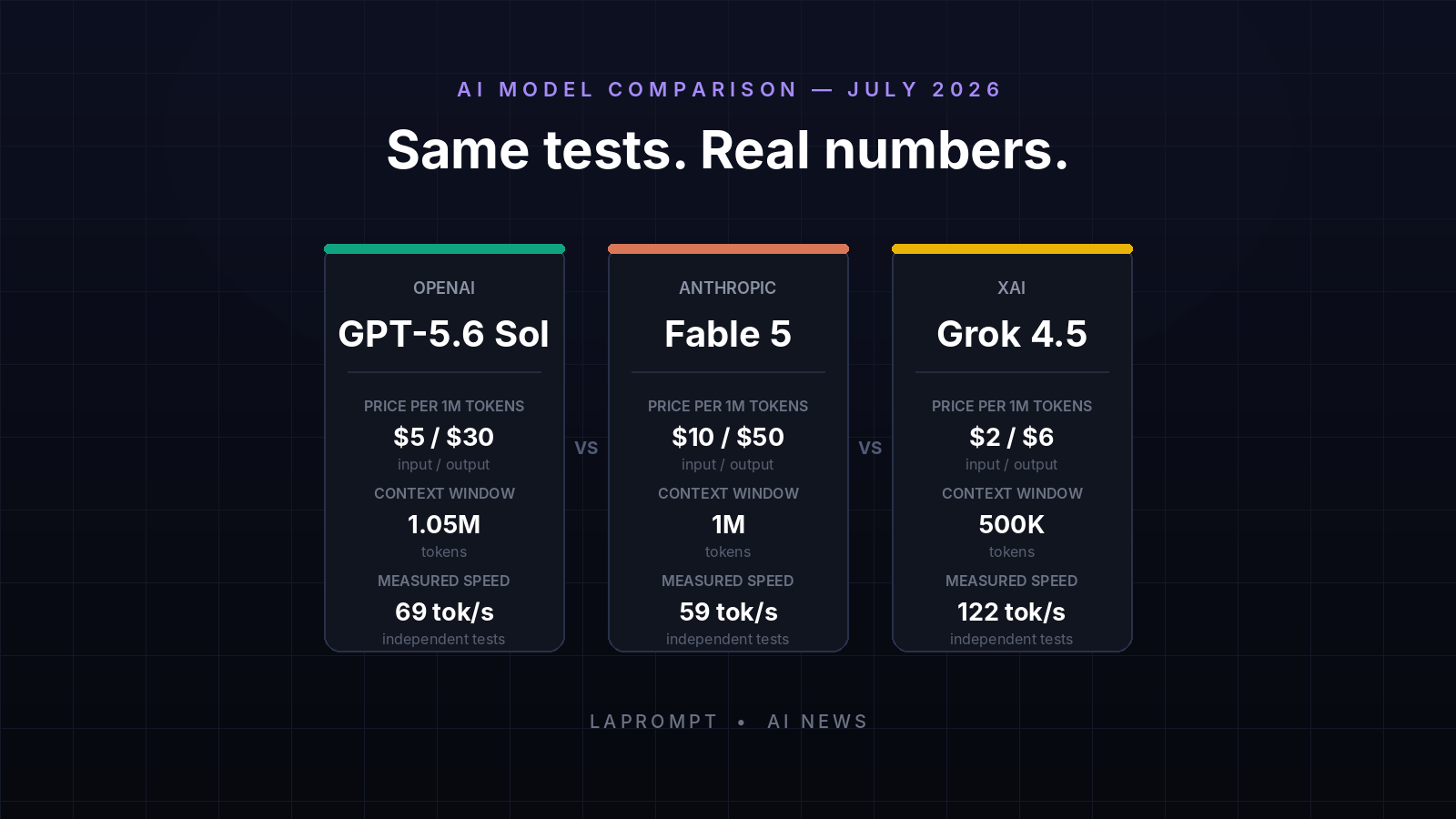 LaPrompt AI News Jul 12, 2026 GPT-5.6 Sol vs Fable 5 vs Grok 4.5: Real Tests and Cost GPT-5.6 Sol vs Claude Fable 5 vs Grok 4.5 across real coding tests, API pricing, speed, context, reliability, benchmarks, and developer feedback.
  LaPrompt AI News Jul 12, 2026 Claude Fable 5 vs Sonnet 5 vs Mythos 5: Which Model Should You Use? Compare Claude Fable 5, Sonnet 5 and Mythos 5 across pricing, 1M context, coding, agents, safeguards, availability and API changes.
Comments
0 totalLoading comments...